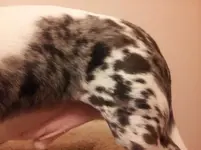
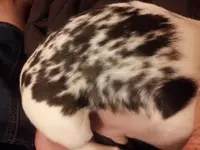
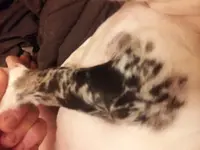
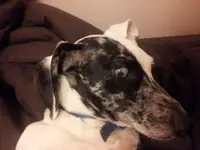
Tweed is a merle modifier that turns the diluted parts of the coat (which should be grey in a normal merle, or light brown in a liver) into a variety of brown, grey and tan shades, resulting in a dog that has very similar markings to an African Wild Dog. It is known to occur in Australian Shepherds and Catahoula Leopard Dogs (where it is known as "patchwork"). It is possible that the tweed mutation occurred in just one of the breeds to begin with and then spread to the other, as interbreeding between the two breeds is common in the USA, or else it simply occurs as a mutation every now and again in breeds in which a high number of merles are bred (more merles increases the possibility of mutation, and merle is known to be a fragile gene that mutates more frequently than most others). Either way, it is a rare and striking pattern. It is often assigned its own locus, Tw, and is thought to be dominant.
Some people claim the existence of two genes which cause the tweed pattern. One causes very random patterning with white patches amongst the grey, brown and black. Australian Shepherd breeders know this as "harlequin", although it is different to the harlequin found in Great Danes (see below).
The second gene is thought to be true tweed. This type of tweed does not include white patches. Sometimes it is also more regular than the "harlequin" type, and the different colours can cover larger areas of the dog. It is not known whether these two types of tweed are caused by separate genes or variations (or modifications) of the same gene.
Tweed can occur in any of the patterns shown on the merle page (with tan markings, white, brindle etc). However, interestingly, it has never been reported to occur on a double merle. It's not at all certain why this is.